Alpbach Summer School: Design of a space mission to a gas Giant
The Saturnian system has been the target of four previous space missions and has generated high scientific interest due to its dynamic atmospheric properties and its many moons, some of which are key targets for the search for habitability. The SIREN mission is designed to study these environments, focusing on three main science goals. Firstly, the mission aims to study Saturn’s atmospheric composition to further understand its formation and evolution. Secondly, it aims to study the Saturnian ring and moon formation and evolution as a proxy for accretion processes in protoplanetary discs. Lastly, the mission will study what chemical processes shape Enceladus’ potentially habitable subsurface and surface environment.
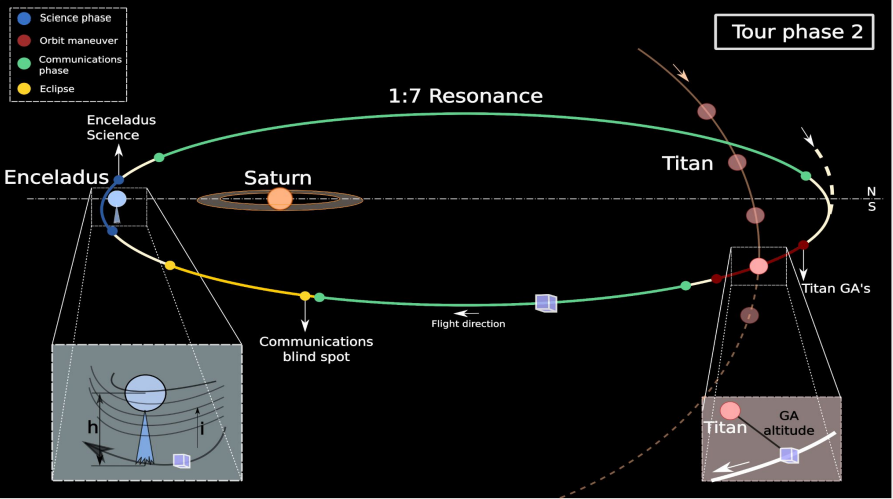
The orbiter will perform multiple flybys of Enceladus at different altitudes crossing the plume to unambiguously characterise its chemical composition as a probe of this moon’s pristine interior material. After that, the orbiter will perform close observations of the A and B rings. The Saturn atmospheric entry probe (ARGO) will carry out measurements during a 90-minute descent to characterize the atmospheric composition down to an altitude of 20 bar.
See the Presentation slides and Report.
Post Alpbach: Concurrent Engineering design of a mission to Neptune
As a continuation of the Alpbach workshop, we continued the development of a space mission, this time to Neptune and its Moon, Triton.
This mission requires a complex trajectory, including a retrograde orbit around Neptune that allows for the mapping of Neptune’s atmosphere and magnetic fields. Then, the spacecraft is inserted into a Triton orbit to map its surface to the last details. It is important to take into account the current regulations for spacecraft disposal at the end of the mission.
Publication coming soon!